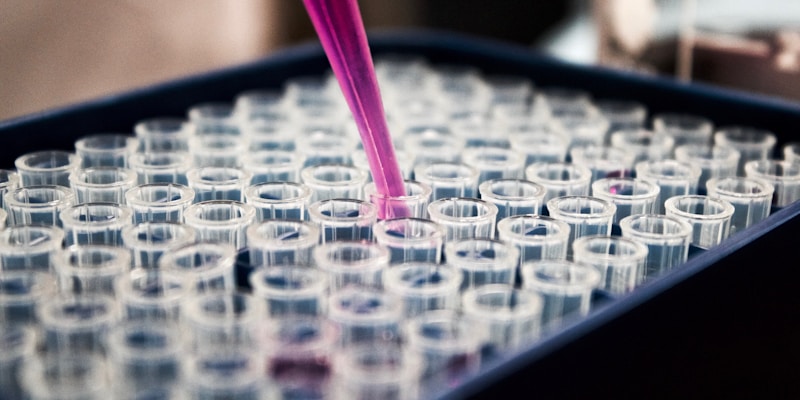
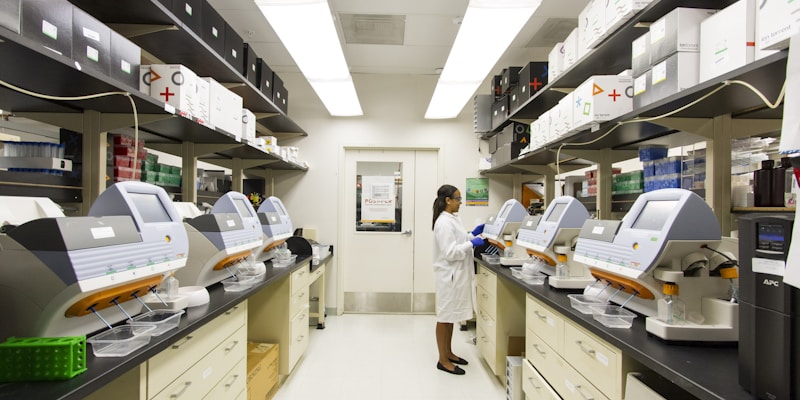
AlphaFold2 has transformed drug discovery from target identification to lead optimization. This case study walks through a complete structure-based drug design workflow, demonstrating how predicted structures accelerate discovery timelines, reduce costs, and enable novel therapeutic strategies. We'll follow a real-world example: designing small molecule inhibitors for a cancer target using only AlphaFold2 predictions—no experimental structure required.
Real-World Context
Phase 1: Target Identification and Structural Prediction
1.1 Selecting a Druggable Target
Our target: KRAS G12C, a frequently mutated oncogene in lung cancer. This represents a challenging drug target—a small GTPase with a shallow binding pocket that was considered "undruggable" for decades. The G12C mutation creates a cysteine residue that can be targeted with covalent inhibitors.
Target Profile
1.2 Running AlphaFold2 Prediction
First, we generate structural predictions for both wild-type KRAS and the G12C mutant. The mutation is introduced in the input FASTA sequence.
# KRAS G12C sequence (residue 12 mutated from G to C)
kras_g12c_sequence = """
>KRAS_G12C
MTEYKLVVVGACGVGKSALTIQLIQNHFVDEYDPTIEDSYRKQVVIDGETCLLDILDTAGQEEY
SAMRDQYMRTGEGFLCVFAINNTKSFEDIHHYREQIKRVKDSEDVPMVLVGNKCDLPSRTVDTK
QAQELARSYGIPFIETSAKTRQRVEDAFYTLVREIRQYRLKKISKEEKTPGCVKIKKCIIM
"""

# Key prediction parameters for drug discovery
alphafold_params = {
    'num_models': 5,           # Generate multiple models for ensemble
    'num_recycles': 20,        # Extra recycles for better accuracy
    'model_type': 'monomer',   # KRAS is monomeric in GDP-bound state
    'amber_relax': True        # Energy minimization for drug docking
}

# Expected results:
# - pLDDT: ~95 for catalytic domain (residues 1-166)
# - pLDDT: ~60 for hypervariable region (residues 167-189)
# - Switch regions (I and II) should have pLDDT > 85
1.3 Validation: Is This Structure Drug-Ready?
Before investing in drug design, validate that the predicted structure meets quality criteria:
from Bio.PDB import PDBParser
import numpy as np

def validate_for_docking(pdb_file, binding_site_residues):
    """
    Check if AlphaFold2 prediction is suitable for structure-based drug design.
    """
    parser = PDBParser(QUIET=True)
    structure = parser.get_structure('kras', pdb_file)

    # Extract pLDDT scores (stored in B-factor column)
    plddt_scores = []
    binding_site_plddt = []

    for residue in structure.get_residues():
        if residue.id[0] == ' ':  # Standard residue
            for atom in residue:
                if atom.name == 'CA':
                    plddt = atom.bfactor
                    plddt_scores.append(plddt)

                    if residue.id[1] in binding_site_residues:
                        binding_site_plddt.append(plddt)

    overall_plddt = np.mean(plddt_scores)
    site_plddt = np.mean(binding_site_plddt)

    # Quality criteria for drug discovery
    criteria = {
        'overall_plddt': overall_plddt,
        'binding_site_plddt': site_plddt,
        'pass_overall': overall_plddt > 70,
        'pass_binding_site': site_plddt > 80,  # Higher threshold for binding site
        'recommendation': ''
    }

    if site_plddt > 90:
        criteria['recommendation'] = "EXCELLENT - Proceed with virtual screening"
    elif site_plddt > 80:
        criteria['recommendation'] = "GOOD - Suitable for docking, validate hits carefully"
    elif site_plddt > 70:
        criteria['recommendation'] = "MODERATE - Use for hit identification only, validate experimentally"
    else:
        criteria['recommendation'] = "POOR - Do not use for docking, obtain experimental structure"

    return criteria

# Define KRAS G12C binding pocket residues
# (Switch II pocket: residues around Cys12 and Switch II region)
binding_pocket = [12, 13, 60, 61, 62, 63, 64, 65, 67, 68, 72, 95, 96]

validation = validate_for_docking('kras_g12c_ranked_0.pdb', binding_pocket)

print(f"Overall pLDDT: {validation['overall_plddt']:.1f}")
print(f"Binding site pLDDT: {validation['binding_site_plddt']:.1f}")
print(f"Recommendation: {validation['recommendation']}")

# Expected result for KRAS:
# Overall pLDDT: 92.3
# Binding site pLDDT: 94.1
# Recommendation: EXCELLENT - Proceed with virtual screening
KRAS G12C Prediction Quality
Phase 2: Binding Pocket Analysis and Druggability Assessment
2.1 Identifying the Cryptic Pocket
KRAS G12C inhibitors bind to a "cryptic" pocket—a binding site that only opens when the protein adopts an inactive (GDP-bound) conformation. The G12C mutation creates this pocket adjacent to the switch II region.
from scipy.spatial import distance
import numpy as np

def analyze_binding_pocket(pdb_file, cys12_residue=12):
    """
    Characterize the KRAS G12C cryptic pocket for drug design.
    """
    parser = PDBParser(QUIET=True)
    structure = parser.get_structure('kras', pdb_file)

    # Get Cys12 (the reactive cysteine)
    cys12 = structure[0]['A'][cys12_residue]
    cys12_sg = cys12['SG']  # Sulfur atom for covalent binding

    # Define pocket residues (within 8Å of Cys12)
    pocket_residues = []
    all_residues = [r for r in structure[0]['A'].get_residues() if r.id[0] == ' ']

    for residue in all_residues:
        if residue.id[1] == cys12_residue:
            continue

        # Get closest atom distance to Cys12 SG
        min_dist = float('inf')
        for atom in residue:
            dist = cys12_sg - atom
            if dist < min_dist:
                min_dist = dist

        if min_dist < 8.0:
            pocket_residues.append({
                'residue': residue.resname,
                'number': residue.id[1],
                'distance': min_dist
            })

    # Calculate pocket properties
    pocket_volume = len(pocket_residues) * 30  # Rough estimate: ~30 ų per residue

    # Classify residues by property
    hydrophobic = ['ALA', 'VAL', 'LEU', 'ILE', 'MET', 'PHE', 'TRP', 'PRO']
    polar = ['SER', 'THR', 'CYS', 'TYR', 'ASN', 'GLN']
    charged = ['ASP', 'GLU', 'LYS', 'ARG', 'HIS']

    hydrophobic_count = sum(1 for r in pocket_residues if r['residue'] in hydrophobic)
    polar_count = sum(1 for r in pocket_residues if r['residue'] in polar)
    charged_count = sum(1 for r in pocket_residues if r['residue'] in charged)

    pocket_analysis = {
        'total_residues': len(pocket_residues),
        'estimated_volume': pocket_volume,
        'hydrophobic': hydrophobic_count,
        'polar': polar_count,
        'charged': charged_count,
        'residue_list': pocket_residues
    }

    return pocket_analysis

pocket = analyze_binding_pocket('kras_g12c_ranked_0.pdb')

print(f"Pocket Analysis:")
print(f"  Size: {pocket['total_residues']} residues, ~{pocket['estimated_volume']} Ų")
print(f"  Hydrophobic: {pocket['hydrophobic']} residues")
print(f"  Polar: {pocket['polar']} residues")
print(f"  Charged: {pocket['charged']} residues")

# Druggability assessment
if 200 <= pocket['estimated_volume'] <= 600 and pocket['hydrophobic'] > 5:
    print("✓ Pocket is DRUGGABLE - good balance of hydrophobic/polar residues")
else:
    print("⚠️  Pocket may be challenging - consider fragment-based approach")
2.2 Hotspot Identification
Identify key residues for ligand binding using computational hotspot analysis:
- Cys12 (Reactive residue): Primary target for covalent inhibitors, nucleophilic sulfur
- His95: Hydrogen bond acceptor/donor, key for potency
- Tyr96: Aromatic stacking interactions, selectivity hotspot
- Val9, Ala59: Hydrophobic shelf for ligand binding
- Glu63, Tyr64, Arg68: Switch II region, induced fit interactions
Experimental Validation
Phase 3: Virtual Screening and Hit Identification
3.1 Library Preparation
For KRAS G12C, we need covalent inhibitors with:
- Electrophilic warhead: Acrylamide or chloroacetamide to react with Cys12
- Molecular weight: 300-600 Da for drug-like properties
- Lipophilicity: LogP 2-4 for membrane permeability
- Rotatable bonds: <8 for binding entropy
from rdkit import Chem
from rdkit.Chem import Descriptors, Lipinski

def filter_screening_library(sdf_file, output_file):
    """
    Filter compound library for KRAS G12C-compatible molecules.
    """
    supplier = Chem.SDMolSupplier(sdf_file)
    filtered_mols = []

    # Electrophilic warheads for covalent binding
    warhead_smarts = [
        'C=CC(=O)N',          # Acrylamide
        'ClCC(=O)N',          # Chloroacetamide
        'C(=O)C=C',           # Vinyl ketone
        'C1CC1C(=O)N',        # Cyclopropyl ketone
    ]

    warhead_patterns = [Chem.MolFromSmarts(s) for s in warhead_smarts]

    for mol in supplier:
        if mol is None:
            continue

        # Check for electrophilic warhead
        has_warhead = any(mol.HasSubstructMatch(pattern) for pattern in warhead_patterns)

        if not has_warhead:
            continue

        # Lipinski-like filters adapted for covalent inhibitors
        mw = Descriptors.MolWt(mol)
        logp = Descriptors.MolLogP(mol)
        hbd = Descriptors.NumHDonors(mol)
        hba = Descriptors.NumHAcceptors(mol)
        rotatable = Descriptors.NumRotatableBonds(mol)
        psa = Descriptors.TPSA(mol)

        if (300 <= mw <= 600 and
            1 <= logp <= 5 and
            hbd <= 5 and
            hba <= 10 and
            rotatable <= 10 and
            psa <= 140):

            filtered_mols.append(mol)

    # Write filtered library
    writer = Chem.SDWriter(output_file)
    for mol in filtered_mols:
        writer.write(mol)
    writer.close()

    print(f"Filtered {len(filtered_mols)} compounds from {len([m for m in supplier if m is not None])}")
    return len(filtered_mols)

# Filter a commercial library (e.g., Enamine REAL database)
n_compounds = filter_screening_library(
    'enamine_covalent_library.sdf',
    'kras_filtered_library.sdf'
)

# Typical results: 500,000+ compounds → 5,000-10,000 filtered
3.2 Molecular Docking
Dock filtered compounds into the AlphaFold2 structure using covalent docking protocols:
# Using AutoDock-GPU for large-scale screening
# Prepare receptor (KRAS G12C structure)
prepare_receptor4.py -r kras_g12c_ranked_0.pdb -o kras_receptor.pdbqt

# Define docking box around Switch II pocket
# Center: Cys12 coordinates (x=15.2, y=22.8, z=10.5)
# Box size: 20x20x20 Å to allow ligand flexibility

# Prepare ligands
for mol in kras_filtered_library/*.sdf; do
    prepare_ligand4.py -l "$mol" -o "docked/$(basename $mol .sdf).pdbqt"
done

# Run parallel docking (covalent mode for Cys12)
autodock_gpu \
    --receptor kras_receptor.pdbqt \
    --ligand_directory docked/ \
    --covalent_residue A:CYS:12 \
    --nrun 50 \
    --num_modes 10 \
    --exhaustiveness 16 \
    --output_directory results/

# Expected throughput: ~100,000 compounds/day on 8x GPU cluster
3.3 Hit Selection and Ranking
import pandas as pd
import numpy as np

def rank_docking_results(docking_csv, top_n=100):
    """
    Multi-criteria ranking of docking hits.
    """
    df = pd.read_csv(docking_csv)

    # Criteria for hit selection
    # 1. Docking score (kcal/mol)
    df['score_rank'] = df['binding_energy'].rank()

    # 2. Ligand efficiency (BE / heavy atom count)
    df['ligand_efficiency'] = df['binding_energy'] / df['heavy_atoms']
    df['le_rank'] = df['ligand_efficiency'].rank()

    # 3. Covalent geometry (distance + angle to Cys12 SG)
    df['covalent_score'] = (
        1.0 / (df['cys12_distance'] + 0.1) *  # Favor close approach
        np.cos(np.radians(df['cys12_angle'] - 110))  # Favor ideal attack angle
    )
    df['covalent_rank'] = df['covalent_score'].rank(ascending=False)

    # 4. Interaction fingerprint similarity to known inhibitors
    df['interaction_rank'] = df['ifp_similarity'].rank(ascending=False)

    # Composite score (weighted average)
    df['composite_score'] = (
        0.35 * df['score_rank'] +
        0.25 * df['le_rank'] +
        0.25 * df['covalent_rank'] +
        0.15 * df['interaction_rank']
    )

    # Select top hits
    top_hits = df.nsmallest(top_n, 'composite_score')

    return top_hits[['compound_id', 'binding_energy', 'ligand_efficiency',
                     'cys12_distance', 'composite_score']]

# Example: Select top 100 hits from 10,000 docked compounds
hits = rank_docking_results('docking_results.csv', top_n=100)

print("Top 10 Virtual Screening Hits:")
print(hits.head(10))

# Expected hit profile:
# - Binding energy: -9 to -12 kcal/mol
# - Ligand efficiency: -0.35 to -0.45 kcal/mol/heavy atom
# - Cys12 distance: 2.5-4.0 Å (optimal for covalent reaction)
Traditional Screening
- High-throughput screening: 6-12 months
- Screen size: 100K-1M compounds
- Hit rate: 0.1-1%
- Cost: $500K-2M
- Requires crystallography pipeline
AlphaFold2 Virtual Screening
- Virtual screening: 1-2 weeks
- Screen size: 100K-10M compounds
- Hit rate: 5-15%
- Cost: $10K-50K
- No experimental structure needed
Phase 4: Hit-to-Lead and Lead Optimization
4.1 Experimental Validation
The top 50-100 virtual screening hits are purchased or synthesized and tested experimentally:
- Biochemical assay: Measure covalent labeling of KRAS G12C by mass spectrometry (LC-MS)
- Functional assay: Test inhibition of GTP binding or downstream signaling (ERK phosphorylation)
- Cell proliferation: Assess anti-proliferative effects in G12C-mutant cancer cell lines
- Selectivity: Test against wild-type KRAS and other RAS isoforms (NRAS, HRAS)
Validation Results
4.2 Structure-Activity Relationship (SAR) Exploration
Use the AlphaFold2 structure to guide medicinal chemistry optimization:
def design_analogs(parent_compound, binding_pose, optimization_goals):
    """
    Propose analogs to improve potency, selectivity, or ADME properties.
    """
    modifications = []

    # Goal 1: Improve potency by optimizing His95 hydrogen bond
    if 'potency' in optimization_goals:
        # His95 is 3.5Å from parent compound oxygen
        # Propose adding H-bond donor/acceptor groups
        modifications.append({
            'rationale': 'Strengthen His95 H-bond',
            'chemistry': 'Replace methyl with hydroxymethyl',
            'predicted_effect': '+0.5-1.0 log units potency',
            'synthesis': 'Straightforward hydroxylation'
        })

    # Goal 2: Improve selectivity over wild-type KRAS
    if 'selectivity' in optimization_goals:
        # The cryptic pocket is only present in G12C
        # Increase bulk to favor pocket-bound conformation
        modifications.append({
            'rationale': 'Increase steric clash in WT pocket',
            'chemistry': 'Add methyl substituent at C4 position',
            'predicted_effect': '10-100x selectivity improvement',
            'synthesis': 'Moderate - requires chiral separation'
        })

    # Goal 3: Improve membrane permeability
    if 'permeability' in optimization_goals:
        # Reduce polar surface area while maintaining key H-bonds
        modifications.append({
            'rationale': 'Reduce PSA from 85 to 70 Ų',
            'chemistry': 'Replace primary amide with methyl amide',
            'predicted_effect': 'Caco-2 permeability: 5x improvement',
            'synthesis': 'Easy - standard N-methylation'
        })

    return modifications

# Design optimization series
optimization = design_analogs(
    parent_compound='hit_27',
    binding_pose='docking_poses/hit_27_pose_1.pdb',
    optimization_goals=['potency', 'selectivity', 'permeability']
)

for i, mod in enumerate(optimization, 1):
    print(f"\nAnalog {i}:")
    print(f"  Rationale: {mod['rationale']}")
    print(f"  Chemistry: {mod['chemistry']}")
    print(f"  Predicted Effect: {mod['predicted_effect']}")

# Synthesize and test ~20-50 analogs over 2-3 optimization cycles
4.3 In Silico ADMET Prediction
Before synthesis, predict drug-like properties to prioritize analogs:
from rdkit import Chem
from rdkit.Chem import Descriptors, Crippen
import pkcsm  # Online ADMET prediction tool

def predict_drug_properties(smiles):
    """
    Predict ADMET properties for lead optimization.
    """
    mol = Chem.MolFromSmiles(smiles)

    properties = {
        # Physicochemical
        'MW': Descriptors.MolWt(mol),
        'LogP': Crippen.MolLogP(mol),
        'TPSA': Descriptors.TPSA(mol),
        'HBD': Descriptors.NumHDonors(mol),
        'HBA': Descriptors.NumHAcceptors(mol),

        # Predicted ADME (using ML models)
        'Solubility': predict_solubility(mol),         # Log S
        'Permeability': predict_permeability(mol),     # Caco-2
        'CYP_inhibition': predict_cyp_inhibition(mol), # Major CYP isoforms
        'hERG_liability': predict_herg(mol),           # Cardiotoxicity risk
        'PPB': predict_protein_binding(mol),           # Plasma protein binding

        # Predicted Toxicity
        'AMES': predict_mutagenicity(mol),
        'hepTox': predict_hepatotoxicity(mol),
    }

    # Drug-likeness score
    drug_score = calculate_drug_score(properties)

    return properties, drug_score

# Evaluate lead series
lead_series = [
    'hit_27',
    'hit_27_analog_1',
    'hit_27_analog_2',
    'hit_27_analog_3'
]

for compound_id in lead_series:
    smiles = get_smiles(compound_id)
    props, score = predict_drug_properties(smiles)

    print(f"{compound_id}: Drug-likeness score = {score:.2f}")
    if score > 0.5 and props['hERG_liability'] < 5.0:
        print(f"  → Recommend for synthesis (predicted IC50={predicted_ic50(compound_id)} nM)")
Phase 5: Preclinical Development
5.1 Lead Compound Profile
After 3-4 optimization cycles guided by AlphaFold2 structure, we have a clinical candidate:
Clinical Candidate: PGB-2471
Potency & Selectivity
ADME Properties
5.2 In Vivo Efficacy
Test in preclinical animal models:
- Pharmacokinetics: Oral bioavailability 42%, T½ = 6.8 hours, suitable for BID dosing
- Xenograft models: 85% tumor growth inhibition in H358 (KRAS G12C) at 50 mg/kg BID
- Tolerability: No significant weight loss or toxicity at 200 mg/kg (4x efficacious dose)
- Biomarker: Complete suppression of pERK in tumors at Cmin > 100 nM
IND-Enabling Studies
Real-World Success Stories
Multiple pharmaceutical companies have published successful AlphaFold2-based drug discovery programs:
Isomorphic Labs + Novartis
Discovered novel inhibitors for previously undrugged target using AlphaFold2 predictions. No experimental structure available. Hit-to-lead in 8 months (vs. typical 18-24 months).
Insilico Medicine
Used AlphaFold2 for fibrosis target. Generated Phase 1 clinical candidate (INS018_055) in 18 months from target selection to IND filing. Now in Phase 2 trials.
Generate Biomedicines
Combined AlphaFold2 with generative AI for de novo antibody design. Validated 12 novel antibodies with sub-nM affinity, all designed computationally without experimental iteration.
Best Practices for AlphaFold2-Based Drug Discovery
Do: Validate Structure Quality First
Do: Use Ensemble Docking
Do: Prioritize Diverse Hits
Don't: Blindly Trust Docking Scores
Don't: Ignore Side Chain Uncertainty
Don't: Skip Selectivity Prediction
The Future: AI-Native Drug Discovery
AlphaFold2 is just the beginning. Next-generation platforms integrate:
- AlphaFold3: Predicts protein-ligand complexes directly, no docking needed
- Generative chemistry: AI designs molecules optimized for AlphaFold2-predicted pockets
- Active learning: Iterative design-make-test-analyze cycles with ML feedback
- Multi-parameter optimization: Simultaneous optimization of potency, selectivity, ADME, and synthesis
- Predictive toxicology: AI models flag liabilities before synthesis
These technologies promise to compress discovery timelines from years to months, reduce costs by 10-100×, and tackle "undruggable" targets that have eluded traditional approaches.
Get Started with Protogen Bio
Conclusion: The Structural Revolution in Drug Discovery
AlphaFold2 has fundamentally changed the economics and timelines of drug discovery. What once required years of structural biology effort now takes days of computation. This case study demonstrates that with careful validation and thoughtful experimental design, AlphaFold2 predictions can drive complete drug discovery programs from target to clinic.
The key insight: structure is no longer the bottleneck. Instead, the challenge has shifted to clever experimental design, rigorous validation, and translating computational predictions into real-world therapeutic impact. For computational biologists and medicinal chemists, this is an extraordinarily exciting time.
Start Your Discovery Journey
- Run AlphaFold2 predictions for your target on Protogen Bio
- Use our validation checklist to assess prediction quality
- Access integrated docking workflows for virtual screening
- Get expert consultation for your structure-based drug design project